Progress

Progress towards a neutral-atom quantum technology

Where our experiments stand today — the systems we have built, what we are working on now, and what comes next.

Research plan

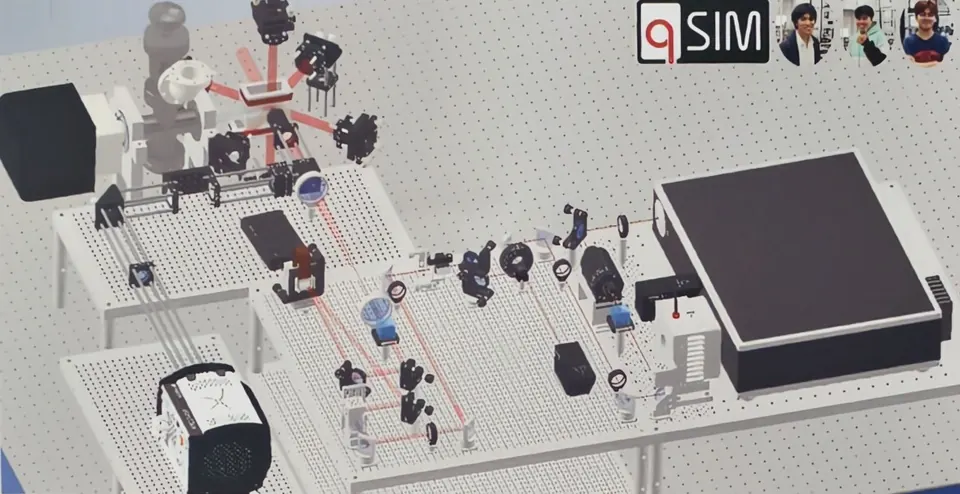
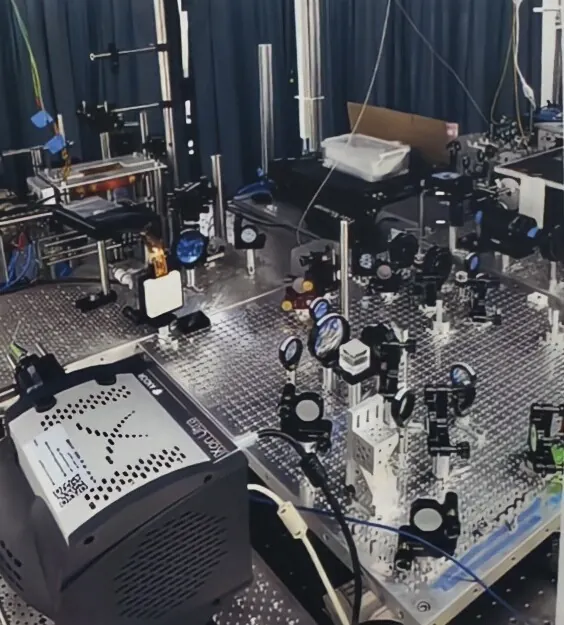
The Quantum Simulation Research Laboratory aims to advance knowledge in quantum technology, with a primary focus on quantum simulation and quantum sensing using Rydberg atom systems. The laboratory investigates the dynamics of atomic quantum states while also establishing the essential infrastructure required for future quantum computing research — including experimental control software, optical systems, electronic and mechatronic devices, and portable quantum devices.

Track 01

Quantum simulation

Reaching quantum simulation requires a highly controlled experimental platform, built step by step: cooling and trapping atoms below the Doppler limit, engineering trapping patterns with uniform intensity and aberration correction, assembling and controlling optical tweezers with multi-frequency capability, and developing atom detection through EMCCD characterization to achieve single-atom detection for accurate quantum-state preparation and measurement.

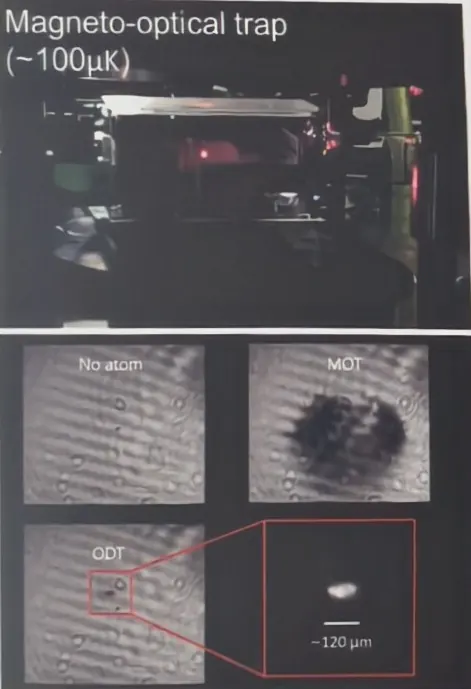
Camera images of the magneto-optical trap and of atoms held in the optical dipole trap
Achieved

Cold atom system

Atoms are laser-cooled in a magneto-optical trap and transferred into an optical dipole trap.

  • Magneto-optical trap at ~100 µK
  • Atoms transferred into an optical dipole trap
  • Magnetic fields characterised for loading, trapping and transfer
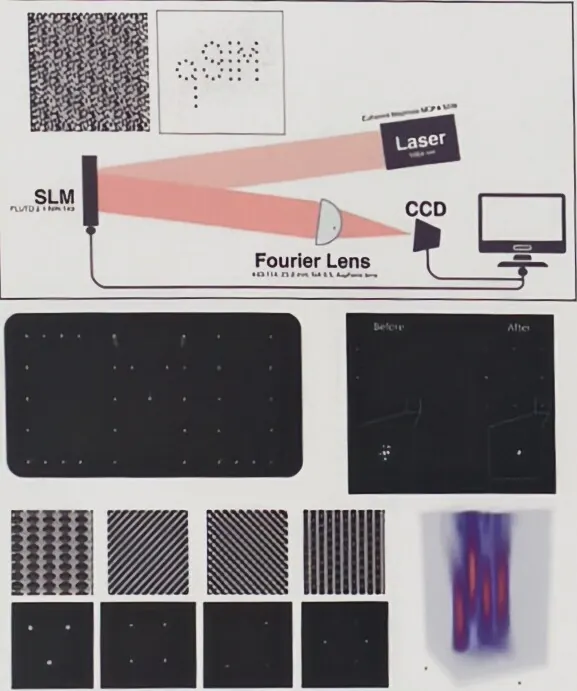
Diagram of the SLM holography setup and camera images of the generated trap arrays
Achieved

Engineering trapping patterns

A spatial light modulator and Fourier lens shape laser light into arrays of optical traps, with holographic aberration correction for uniform trap intensity.

  • SLM holography with a Fourier lens and CCD feedback
  • Aberration-corrected trap arrays
  • Simulated phase addition for 3D optical tweezers
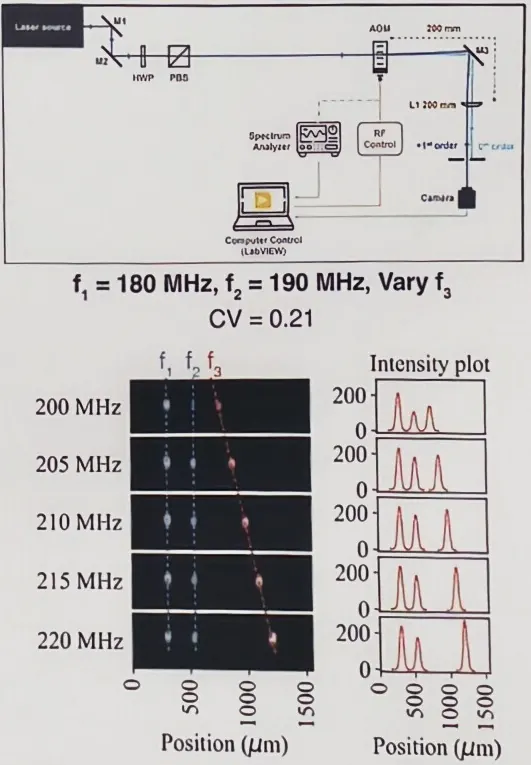
AOD optical setup diagram with camera images and intensity plots of three tweezer beams as one frequency is scanned
In progress

Optical tweezers / AOD

An acousto-optic deflector driven at several radio frequencies at once creates multiple movable tweezer beams — the tool for rearranging atoms one by one.

  • Multi-frequency drive: f₁ = 180 MHz, f₂ = 190 MHz, f₃ scanned 200–220 MHz
  • Beam-intensity uniformity CV = 0.21
  • Computer-controlled RF and camera feedback
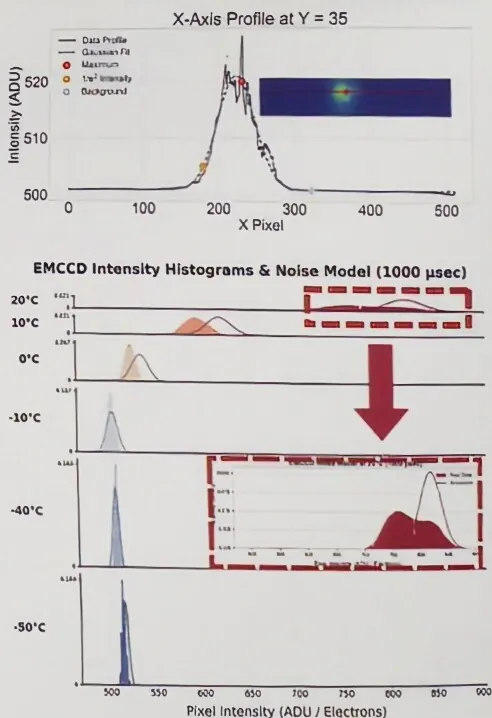
Beam profile plot and EMCCD intensity histograms at camera temperatures from 20 to minus 50 degrees Celsius
In progress

Imaging system

An EMCCD camera is characterised from room temperature down to −50 °C to model its noise — the basis for detecting single atoms.

  • Beam profiling and Gaussian fitting
  • EMCCD intensity histograms and noise model from 20 °C to −50 °C
  • Goal: reliable single-atom detection

Track 02

Quantum sensing

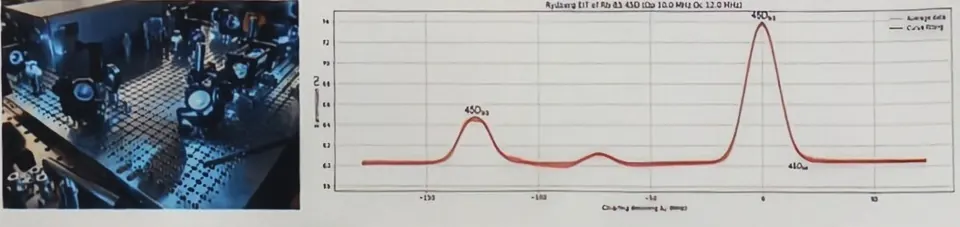
Quantum sensing with Rydberg electromagnetically induced transparency (Rydberg EIT) relies on the exceptional sensitivity of Rydberg atoms to external electric fields. Fabricating our own rubidium vapor cells is a crucial part of this, because it provides the controlled atomic environment needed for stable, high-sensitivity detection.

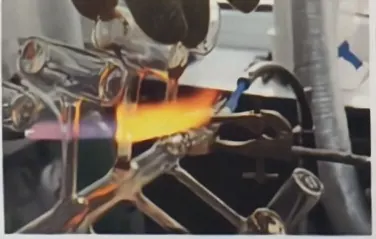
Glassblowing flame used to fabricate a rubidium vapor cell
Achieved

Rubidium vapor cell fabrication

Glass vapor cells are made and filled with rubidium in-house, then characterised by absorption spectroscopy.

  • Home-made rubidium vapor glass cells
  • Temperature-dependent absorbance measured
  • Spectroscopic characterization and vapor-pressure analysis

Next steps

What comes next

01Planned

Single-atom detection

Use the characterised EMCCD to image individual atoms in the tweezers with high fidelity.

02Planned

Deterministic single-atom arrays

Rearrange atoms with the AOD tweezers into defect-free arrays, atom by atom.

03Planned

Rydberg spin-½ quantum simulator

Couple ground and Rydberg states of trapped atoms to build interacting spin systems for quantum simulation.

04Planned

Portable quantum sensors

Turn Rydberg-EIT vapor-cell sensing into compact, field-ready electric-field sensors.

With support and collaboration from

  • Chiang Mai University
  • PMU-B
  • TSRI
  • ThEP Center
  • QTRic